When a Large Tree Needs to Come Down
Nobody removes a big shade tree for fun. Usually something has changed.
Some of those can be fixed without losing the tree. If the trunk and roots are sound and the trouble is a few heavy limbs, trimming might be all you need, and we'll say so. We don't cable or brace trees, though, and we don't diagnose disease. If the tree needs that kind of help, it's someone else's work.
- It's dead or mostly dead, and the limbs coming off are big enough to go through a roof
- The trunk has a long crack, a hollow, or a split where two main stems meet
- It has started leaning, or the ground is heaving on one side of the roots
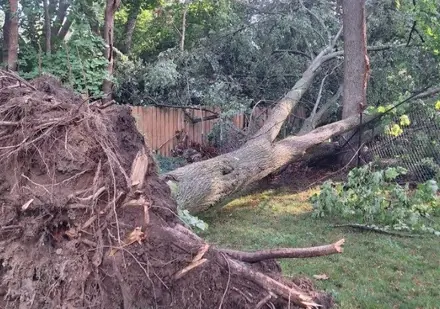
- A storm took out a main limb and left the rest lopsided
- Roots are lifting the driveway or pressing on the foundation
- It has simply outgrown the spot, with heavy limbs resting over the house
Large Tree Removal Quotes Start With a Free Visit
Small jobs we price from photos. Big removals we come look at. It's free, and it's the only way to give you a number that holds.
On that visit we're looking at things a picture doesn't show: which way the tree leans, how sound the trunk is, what's under each side of the crown, where the wires run, how we'd get through the gate, and where brush and logs can be staged. Then you get a written price. One flat number for the whole job, agreed before any cutting.
Still send photos first. Text one of the whole tree, one of the base, and one from the street to (224) 944-8652 with your town, so we know what we're coming to see.
How a Big Tree Comes Down in Sections
In an open field, a tree gets a notch and a back cut and falls in one piece. In a yard, there's almost never room for that. A tall tree needs a clear lane as long as the tree is tall, and most lots have a house, a garage or a neighbor in the way. So it comes down in sections.
All day long the ground crew keeps the area clear, feeding brush to the chipper and moving logs so the climber always has a clean place to land the next piece.
This is the same basic method as any tree removal we do. A big tree just has more pieces, heavier pieces, and less room for error.
- Set up the drop zone. Anything movable gets moved. The landing area is picked so pieces come down on lawn, not on the patio or the flower beds.
- A climber goes up on ropes and ties in.
- Limbs come off first, usually starting with the lower ones and working up, so falling brush has a clear path.
- Limbs over open ground are cut and dropped. Limbs over a roof, fence or garage are tied off and lowered on ropes by the ground crew.
- Once the limbs are gone, the top comes off, then the trunk is cut down in short pieces.
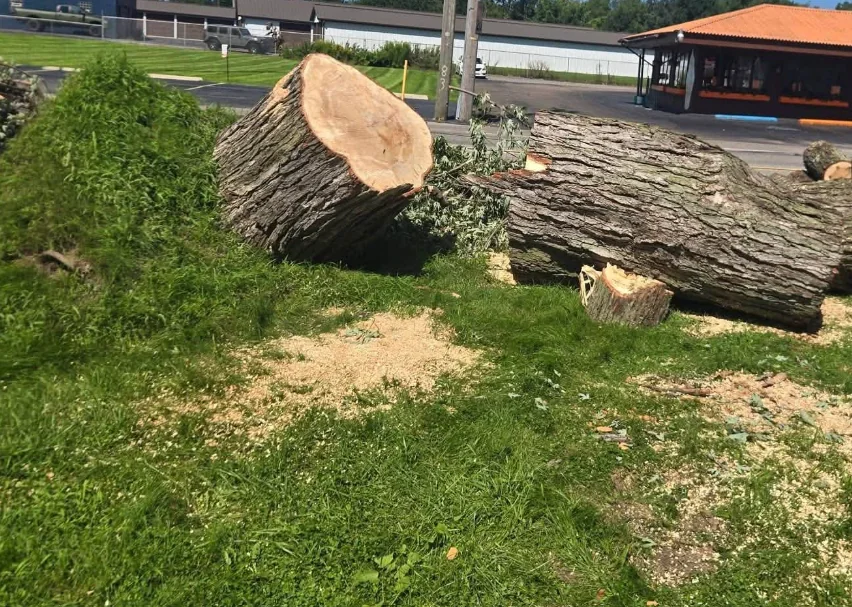
- The last stretch of trunk is felled or cut at ground level, as low as the chainsaw can safely get.
Big Trees Over Roofs, Garages, Fences and Wires
Size alone doesn't make a removal hard. What's underneath does.
About wires. The line from the pole to your house is one thing to plan around. The lines along the street or the back lot line are another. If a tree is touching or tangled in those, that's ComEd's job first. Call them, and call us once they've cleared it.
Then there's ground you can't work on at all. Along the lake, where we handle large tree removal in Lake Bluff, some trees stand at the edge of a ravine or the bluff. Nothing can be dropped downhill and left there, and the footing is poor, so every piece has to come back up to the yard.
| What's under or near the tree | How the plan changes |
|---|---|
| Open lawn | Limbs and trunk sections can be dropped. The quickest kind of big removal. |
| House or garage roof | Every piece over the roof is roped and lowered. Smaller cuts, more time. |
| Fence, shed or deck | Pieces are swung clear on ropes or lowered into a narrow landing spot. |
| Neighbor's yard | We work from your side where we can. If limbs hang over, the neighbor needs a heads-up. |
| Wire to the house | Limbs are roped away from it. Anything in or touching power lines is not our work. |
| Street or sidewalk | The walk gets blocked off while pieces are coming down. |
Access: Getting a Large Tree Out of a Tight Backyard
Cutting the tree is half the job. The other half is getting it out. A big tree turns into a lot of brush and a lot of heavy logs, and all of it has to travel from the backyard to the street.
If equipment can reach the tree, the work goes quicker. If the only way in is a narrow gate or a side yard between two houses, the wood gets cut smaller and carried out by hand. That's more labor, and it shows in the price.
Heavily wooded lots have their own version of this. In places like the ones where we do big tree removal in Riverwoods, the house sits in among mature oaks, and the tree that has to go may be surrounded by ones that are staying. Pieces get lowered straight down through a small opening so the trees around it don't get torn up.
What a Large Tree Removal Price Is Built On
No dollar figures here, because a big removal can't be priced honestly without seeing it. But the things that set the number are always the same.
You'll know the price before anything is cut, and it's one number for the job. The pricing page explains the quote process.
- Size. More tree means more cuts, more rope work and more wood to haul.
- Location. Open yard is the easy end. Over a roof, a fence, a garage or wires is the hard end.
- Condition. Dead and brittle wood is harder and slower than sound wood.
- Access. Whether equipment can reach the tree or everything gets carried.
- The stump. Included or left.
Village Permits for Removing a Mature Tree in Lake County IL
Big, old trees are exactly what village tree rules are written about. Many Lake County villages have them, and some require a permit before a tree is removed, even when it's on your own lot. Your village may want a permit for it, so ask at village hall before anything else.
Do it early. A removal can't go on the calendar until you know you're allowed to do it. That's true in older towns full of mature shade trees, the kind of streets where we do tree removal in Barrington, and it's true in newer ones.
If the tree stands in the parkway between the sidewalk and the street, ask the village about that too. It may not be yours to remove.
The Stump, the Logs and the Cleanup
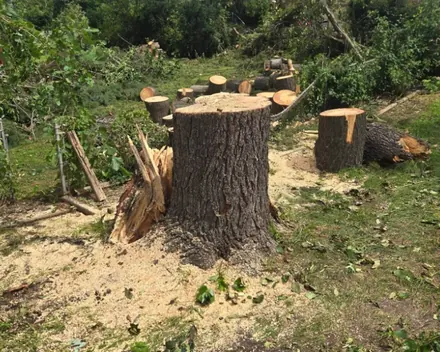
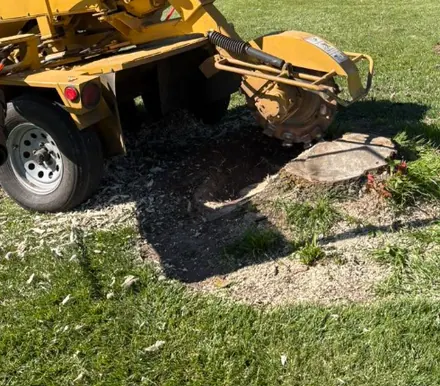
A big tree leaves a big stump. The removal price covers cutting it low. Getting rid of it is a separate choice. If you want lawn or a patio there, add stump grinding to the job. Buried utilities have to be marked before grinding, which in Illinois is a free call to JULIE at 811.
The wood: unless you tell us otherwise, we haul it all. Brush is chipped, logs are loaded, and since Illinois keeps yard waste out of landfills, it's recycled. If you'd like firewood, tell us before the job and we'll leave it cut where you want it. Know what you're asking for. A big oak or maple is a serious pile, and the rounds from the trunk are heavy and still need splitting.
Then the yard gets raked, and sawdust gets cleaned off the drive and the walks. A big removal does leave marks. Expect some dents in the lawn where heavy pieces landed, even with care. Dry or frozen ground holds up best, which is one reason winter is a good time for this kind of job.
Getting Ready for Removal Day
Have questions before you commit? Get in touch and ask. We're around Monday through Saturday, 7am to 7pm, and Sunday by appointment.
- Sort out the permit with village hall
- Clear the driveway and, if you can, the curb in front of the house
- Move patio furniture, grills, planters and anything breakable out of the yard
- Point out sprinkler heads, septic lids, wells, dog fences and landscape lighting
- Talk to the neighbors, especially if limbs hang over their side or we need to step onto their lawn
- Plan for noise. Chainsaws and a chipper run for most of the job
- Keep kids, pets and curious onlookers well back
Where Big Tree Removals Go Wrong
Topping it to make it safer. Cutting the top flat doesn't make a big tree safe. It makes it ugly and weak, and what grows back is poorly attached. We don't top trees. If it needs to be smaller, proper trimming does that. If it needs to go, it goes.
Waiting until it's dead. A big tree that's dying is a normal job. Once it's dead and dry, a climber can't trust it, and the options shrink. Our dead tree removal page explains why that costs more.
Hiring on price alone. Ask whoever you hire if they're insured for tree work. We are. A big tree over a house is not where you want to find out the answer was no.
Doing part of it yourself. Taking off the easy lower limbs to save money usually removes the spots a climber would have used and leaves a mess to work around.
Not saying what you want done with the wood until the truck is loaded.