First Things to Do When a Tree Falls on Your Property
A tree on the roof or across the driveway gets the heart going. Slow down and take these in order.
- Check on people first. If anybody is hurt or trapped, call 911.
- Look for wires. If the tree took down a line or is leaning on one, stay far back and treat every wire as live.
- If the tree hit the house, get everybody out of the rooms under it. Smell gas? Get out and phone the gas company once you're outdoors.
- Stay off the roof and out from under hanging limbs.
- Keep kids, pets and curious neighbors away from the tree.
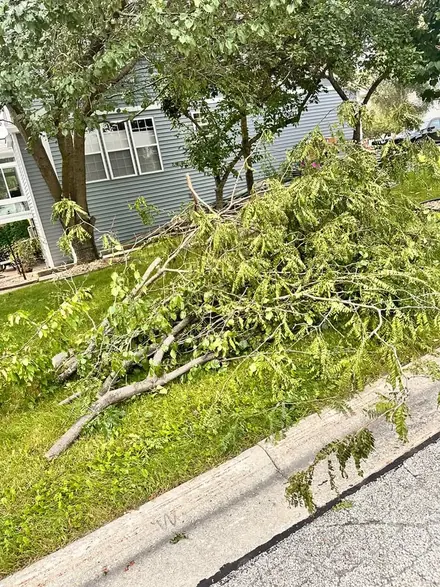
- Take photos from a safe distance.
- Then call us at (224) 944-8652.
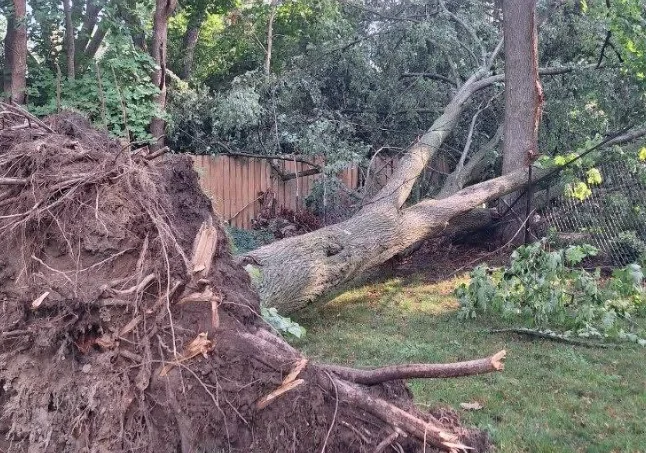
Call, Don't Text, for a Tree on a House, Car or Driveway
For ordinary jobs we ask for a text with a photo. Storm emergencies are different. If a tree is on a house, on a car or blocking your driveway, call so we can talk it through right away.
We work Monday through Saturday, 7am to 7pm, and Sundays by appointment. We won't promise you a clock time, because after a big storm a lot of people are calling at once and roads may be blocked. Storm calls get handled as fast as the crew can reach you.
When you call, tell us your town, what the tree landed on, whether any wires are involved and whether you can get in and out of the house. That's enough to plan around.
We cover the whole county from Libertyville, right up to the state line. A call for emergency tree service in Antioch gets the same crew as one from down the street.
A limb down in the backyard that isn't on anything can go by text with a photo. Both ways to reach the crew are on the contact page.
Who to Call First After Storm Damage in Lake County IL
We aren't always the first call. This table sorts it out.
| What happened | Call first | Where we come in |
|---|---|---|
| Somebody is hurt or trapped, or there's a fire | 911 | After emergency crews have cleared the scene |
| Tree or limb is on or tangled in power lines | ComEd | Once the utility has made the lines safe |
| Tree is on the house, garage or car, no wires | Us, by phone | Getting the tree off and the wood cleared |
| Tree is blocking your driveway | Us, by phone | Cutting a way out, then clearing the rest |
| Tree is across a public street | Your village | Your side of it, once the street is handled |
| Broken limb hanging in the tree or lying in the yard | Us, by text with a photo | Taking down the hanger and hauling the debris |
Downed Wires and Trees in Power Lines
A tree touching or tangled in power lines is the power company's job first. ComEd is the electric utility here. Working in or touching power lines isn't something we do, and nobody else on your property should try it.
A line on the ground can be live without sparking or humming. So can a wet tree lying across it, and so can a metal fence it's touching. Power being out on your block doesn't mean a wire is dead.
Once ComEd has cleared the lines or shut them off, call us back and we'll deal with the tree.
While You Wait for the Tree Crew
There are a few useful things you can do from the ground.
- Move cars that aren't pinned away from the tree, if you can do it safely.
- Unlock the gates.
- If rain is coming through the roof, set out buckets and towels inside and move what you can. Leave the outside alone.
- Call your insurance company and ask what they need from you.
- Write down what was damaged while it's fresh.
- Keep everybody out from under the tree, including after the wind stops.
How We Clear a Fallen Tree, Step by Step
Storm work is slower than it looks from the sidewalk. That's on purpose.
- Size it up. Before any cut, we figure out what's holding the tree where it is: the roof, a fence, its own branches, or roots still half in the ground.
- Check for wires again.
- Take the weight off. Limbs that aren't holding anything up are cut away first to lighten the load.
- Tie off what could move. Sections that could roll, slide or drop farther into the roof are held with ropes before they're cut.
- Cut small. Wood resting on a house comes off in short pieces, from the tips back, so nothing shifts suddenly.
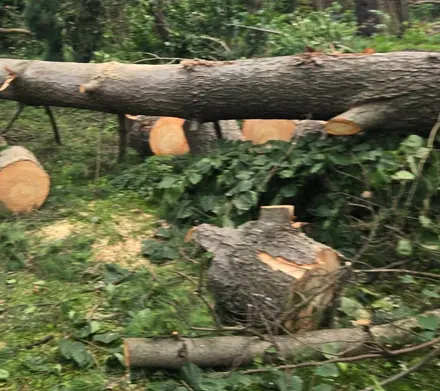
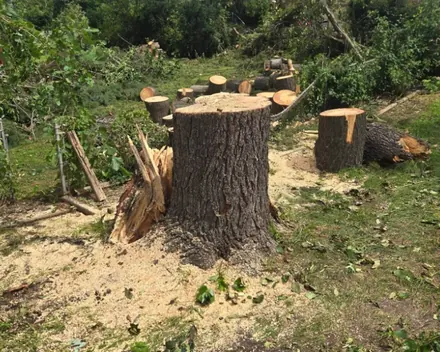
- Handle the trunk and the root end. The trunk is cut into sections with a chainsaw. If the roots tipped up out of the ground, that end gets extra care, since it can drop back into its hole when the trunk's weight comes off.
- Chip, load and rake.
Storm Debris Cleanup and Hauling
A whole tree down across the lawn with nothing under it is a simpler version of the same job. There's more detail on clearing a tree that's already on the ground.
Then comes the mess. Storms leave branches, leaves and split wood everywhere, not only where the tree landed. Brush is chipped, logs are hauled and the yard is raked. Illinois keeps yard waste out of landfills, so it's all recycled. If the whole yard is covered, look at full storm debris cleanup. And if you'd like to keep the wood, say so and it's left cut where you want it.
We remove trees. We don't repair roofs, fences or gutters, so have a roofer or contractor lined up for after the tree is off.
Why Storm-Damaged Trees Are Harder to Cut
A standing tree is predictable. A fallen one is not. Here's what changes.
- Wood under load. A trunk bent over a roof ridge or a limb pinned under the tree is loaded like a spring. Cut it in the wrong place and it snaps up, drops or kicks sideways.
- Hangers. Broken limbs caught up in the crown can fall with no warning, sometimes days later.
- Split trunks. A tree that lost half its top often has a crack running down the trunk. What's still standing may not stay standing.
- Tipped roots. A root ball standing on edge can fall back or roll.
- Bad footing. Wet grass, mud, a sloped roof, branches underfoot.
- Dead ash. Emerald ash borer has killed most untreated ash in Lake County. Dead ash gets brittle fast, so it breaks where a live tree would bend.
Insurance Photos, Village Permits and What Emergency Tree Work Costs
Take pictures before anything is moved, as long as you can do it from a safe spot. Get wide shots that show the whole tree and what it hit, then closer ones of the damage, then the base of the tree. Call your insurer early and ask what they cover. Policies differ, and we can't tell you what yours pays for.
Many Lake County villages have tree rules. If the storm left a damaged tree standing that now has to come out, your village may require a permit, so check with village hall first. Trees in the strip by the street usually belong to the village, so report those to them.
Even in an emergency, you get one flat price and you agree to it before any cutting. The quote is free. It's based on the size of the tree or limb, what it landed on, the condition of the wood, access, and whether a stump is part of the job. More on that is on our pricing page.
Tight lots raise the stakes. In built-up towns, storm tree work in Deerfield for example, a fallen tree is often on a roof, a fence or the neighbor's garage, and there's seldom an easy side to work from.
Every town is quoted the same way. Storm damage tree service in Zion is priced like a job in Libertyville: by the tree and what it's sitting on.
Storm Cleanup Mistakes and Trees to Fix Before the Next Storm
The mistakes that make a bad day worse:
- Cutting it yourself. Storm wood is about the worst wood there is to run a saw through, for the reasons above.
- Assuming a line is dead because the power's out.
- Climbing on the roof to look around while the tree is still on it.
- Pulling a tree off a car or roof with a truck and a chain.
- Cleaning up before taking photos.
- Hiring the first crew that knocks without asking if they're insured for tree work and without a written price.
- Ignoring a hanging limb because the storm's over.
- Having a damaged tree topped to "save" it. Topping is bad practice and we don't do it.