What to Do First When a Tree Falls on Your Property
Do these in order.
After a big storm, a lot of people call at once. We can't promise a time. What we can tell you is that storm calls are handled as fast as the crew can get there.
- Look for wires before anything else. If the tree took down a line or is leaning on one, stay far back and keep everybody else back too. Treat every wire as live. Call ComEd. If something is sparking or burning, call 911.
- If it hit the house, get people out of the rooms under it. Don't go up in the attic to look. If you smell gas, leave and call the gas company from outside.
- Take photos for your insurance company. Lots of them, from every side, before a single branch is moved. They'll want to see the tree where it landed and whatever it hit.
- Call your insurance company if the house, garage, fence or car is damaged. Ask what they need from you before the tree is moved.
- Call us at (224) 944-8652. If the tree is on a house, on a car or blocking the driveway, call instead of texting. For a tree lying in the back yard that isn't hurting anything, a text with a photo and your town is fine.
- Leave the chainsaw in the garage. The reasons are further down this page.
Fallen Tree Removal in Lake County IL: What We Do and Don't Do
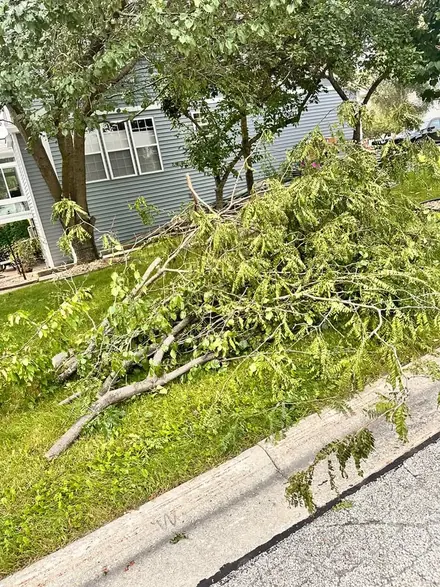
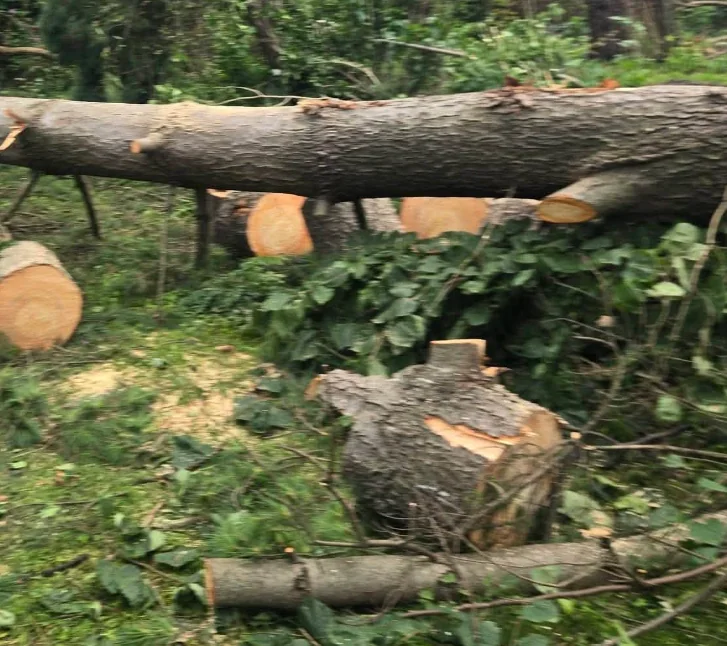
We cut up and remove trees that have gone over on lawns, fences, sheds, garages, houses, cars and driveways. Then we clean up and haul the brush and wood away. It's part of the emergency tree work we do all over the county.
Here's what we don't do. We don't work on a tree that's in or touching power lines. ComEd goes first, and we take what's left once the wires are dealt with. We don't repair roofs, fences or cars. And we don't deal with your insurance company for you. You get a written price from us that you can hand to your adjuster. The claim itself is between you and them.
This page is about whole trees that have come down. If what you have is a broken top, hanging limbs or a yard full of branches, that's covered under cleaning up after storm damage.
| Where the tree landed | Call or text us | Who else to call |
|---|---|---|
| On the house or garage | Call | Your insurance company, and a roofer for the repair |
| On a car | Call | Your insurance company |
| Across the driveway | Call | Nobody, unless wires are involved |
| On or near power lines | Call ComEd first | 911 if there's fire or sparking |
| On a fence or shed | Text a photo, or call | Your insurance company if there's damage |
| Flat on the lawn | Text a photo and your town | Nobody |
How the Crew Cuts Up and Removes a Downed Tree
A fallen tree looks like a simple firewood job. It isn't. Here's how it's taken apart.
- Walk the whole tree. Where is it resting? What's holding it up? Which limbs are bent under load? Did the roots lift out of the ground?
- Start at the tips. Small branches come off first, working from the top of the tree back toward the trunk. That takes weight off and lets us see what's underneath.
- Read the strain in the wood. A downed tree is full of limbs bent like a bow. Cut one on the wrong side and it snaps back at you or pinches the chainsaw. Each cut is made for where the wood wants to go.
- Hold it before cutting it. If the trunk is bridged between the stump and a roof or fence, it's tied off with ropes or blocked up so it can't drop or roll once the weight changes.
- Cut the trunk into lengths that can be carried or rolled out.
- Watch the root plate. A tipped-up root ball can slam back into its hole once the trunk is cut free. Nobody stands on that side, and the last cut is made with that in mind.
When the Tree Is on the House, Garage or Car
Getting a tree off a roof is slower than cutting one up on the grass. The goal is to take weight off the building without letting anything shift and do more damage.
The crown comes apart first, piece by piece, from the outside in. A limb that punched through the roof is cut off outside the hole and left alone until the weight around it is gone. Then it's drawn out. Sections above the roof are held on ropes and lowered. They don't get dropped or rolled off the edge.
Once the tree is off, the hole belongs to a roofer. We don't repair roofs. Line one up early, or ask your insurance company who they'd send, so the opening gets covered soon after the tree is gone.
A car is the same idea. Don't try to drive out from under the tree. In Highwood, where houses, garages and parked cars sit close together, a tree that goes over is likely to land on something, and usually on more than one thing.
What Makes a Downed Tree Job Harder
The hardest one is a tree that didn't make it to the ground. It's hung up in the tree next to it, leaning, waiting. Nobody can say when it'll finish falling. Stay out from under it.
Uprooted trees are harder than snapped ones. The root plate is heavy and loaded, and the hole it left is part of the job site. Near the Chain O'Lakes, in places like Ingleside, big willows and cottonwoods grow in soft ground by the water, and those often come up roots and all.
Dead wood is harder than live wood. A dead ash is brittle and breaks without warning, so it can't be trusted to bend or hold the way green wood does.
And there's getting to it. On the bigger, more rural lots up around Wadsworth, a tree can come down across a long driveway or a fence line far from the road, and reaching it is half the job.
Why Trees Fall Over: Roots, Rot and Wind
We don't diagnose tree disease. But once a tree is down, the reason is often right there to see in the roots or in the break.
If one tree came down, look hard at the ones next to it. Trees that grew up together sheltered each other. With one gone, the rest take wind they never had to stand up to before. If there's another dead ash in that row, it should come down sooner, not later.
- Soaked ground and wind. Roots lose their grip in mud, and the whole tree tips.
- Rotten roots. The top looked fine. The roots were gone.
- A weak fork, where two trunks grew side by side and split apart.
- Dead ash. Emerald ash borer has killed most of the untreated ash in Lake County, and dead ash gets brittle fast.
- Roots cut during digging for a driveway, an addition or a trench.
What Fallen Tree Removal Is Priced On
Quotes are free. You get one flat price for the job, agreed before any cutting, even when it's urgent. We don't publish prices because the same tree can be two very different jobs depending on where it landed.
A tree flat on the grass with a clear path to the street is the simple end. A big oak across a garage roof, with its stump tipped up behind a fence, is the other end. There's more about how we quote on the pricing page.
If the tree is down but nothing is urgent, you can also send the details through the contact form.
- How big the tree is.
- Where it landed: open yard, or on a roof, fence, garage or car.
- Its condition. Dead and brittle is harder to handle.
- Access for getting the wood and brush out.
- Whether the stump is included.
Cleanup, Hauling and the Stump Left Behind
The brush gets chipped. The trunk is cut up and hauled away. Illinois keeps yard waste out of landfills, so all of it gets recycled. If you want the wood for firewood, say so, and it's left cut where you want it.
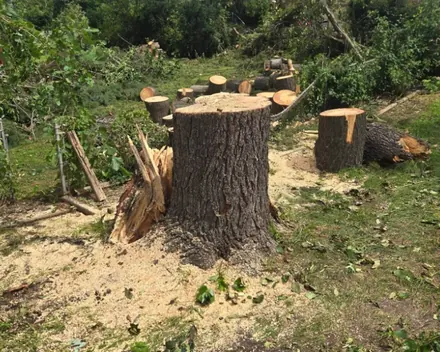
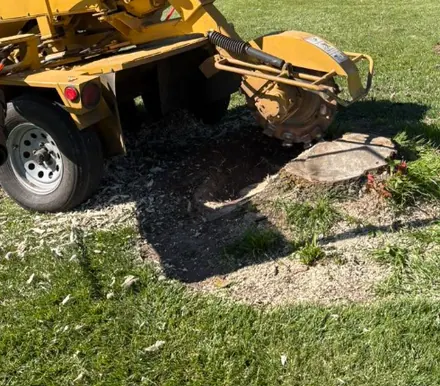
Then there's the stump. If the tree snapped, you have a jagged stub still standing. That gets cut down low. If the tree uprooted, the root plate often settles back toward its hole once the trunk is off. Either way, grinding out what's left of the stump can be part of the same price. The underground utilities have to be marked first, which is a free call to JULIE at 811.
We leave the yard raked. We don't fill holes with soil, reseed or fix ruts. That's landscaping, and we don't do it.
Mistakes People Make With a Downed Tree
A tree lying still can hurt you as badly as one that's falling.
- Cutting it up yourself. Bent wood springs when it's cut. People get hit by limbs they thought were dead weight.
- Climbing on the roof to look at the damage. The roof just took a hit. Don't add your weight to it.
- Clearing branches before taking photos. Once it's moved, you can't show the insurance company how it landed.
- Deciding the wires are dead because the lights are out. They may not be.
- Letting kids play around an uprooted stump. That root plate can drop back into the hole.
- Hiring whoever knocks on the door after the storm. Ask anybody you hire, us included, for proof of insurance and a price in writing before a saw starts.
Village Permits and Whose Tree It Is
Many Lake County villages have tree rules, and your village may require a permit before a tree is removed, even on private property. How that applies to a tree that's already on the ground varies, so check with village hall first if you can.
A tree that stood in the strip between the sidewalk and the street is often the village's tree. Call them before you pay to have it removed.
If a neighbor's tree fell into your yard, who pays is a question for your insurance company. A tree crew can't answer it.