Sorting Out Storm Damage: What's Urgent and What Can Wait
Not everything in the yard is an emergency. Some of it is. Use this to sort it.
If a tree or a big limb is on the house, on a car or blocking the driveway, call (224) 944-8652. Don't text for those. For everything else, a text with photos and your town works fine.
We don't promise a response time. The crew handles storm calls as fast as it can get there.
| What you see | How urgent | What to do |
|---|---|---|
| A limb or tree on wires | Dangerous right now | Stay back and call ComEd |
| A broken limb hanging over a door, walk or driveway | Urgent | Keep people out from under it and call us |
| A trunk split down the middle | Urgent | Stay clear of both halves and call us |
| A tree leaning that wasn't leaning yesterday | Urgent | Stay off the side it leans toward and call us |
| Limbs lying on the roof, no hole | Soon | Take photos, then call or text |
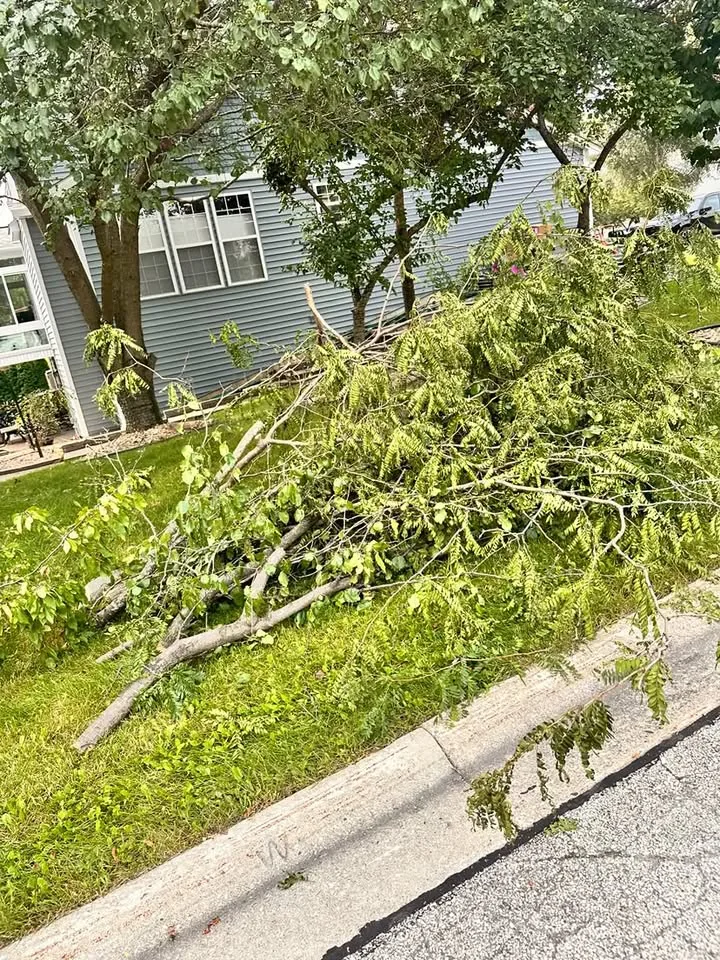
| Branches scattered on the lawn | Can wait | Text a photo and your town |
Before You Touch Anything After a Storm
Give the yard a slow look from the doorway before you walk out into it.
- Find the wires. Power lines get pulled down with limbs and end up hidden under leaves. If you see a line down or a branch resting on one, don't go near it. Call the power company, which is ComEd around here.
- Look up. The limb that hurts people is the broken one still caught in the canopy. Check overhead before you walk under any tree.
- Get your camera out. Take photos for your insurance company before you move a thing: wide shots of the whole yard, then close shots of anything a limb landed on.
- Keep kids and dogs inside until the hanging stuff is down.
- Small stuff is yours if you want it. If you can lift a branch with one hand and nothing is resting on it, it's safe to drag to a pile.
- Anything bigger, anything bent, anything overhead: leave it.
What Our Storm Damage Cleanup Covers in Lake County IL
Storm cleanup is one piece of our emergency tree service. On a storm job the crew takes down hanging and broken limbs, cuts torn branches back to sound wood, removes trees too damaged to keep, and hauls off the brush and wood.
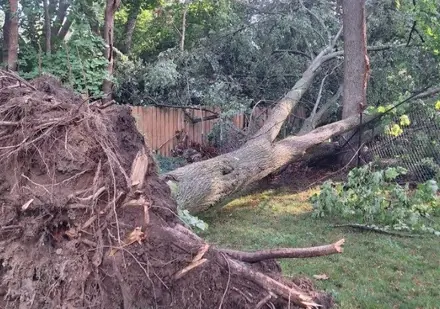
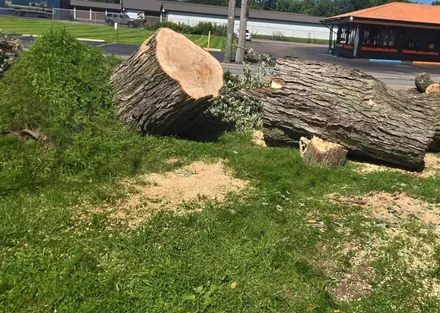
When the whole tree is lying on the ground, that's its own kind of job, and it's covered under getting a fallen tree cut up and removed. And if the storm only cost you one branch, having that one limb taken off may be all you need.
Some things we don't do, and it's better you hear it now.
- No work in or touching power lines. That's ComEd's job first.
- No roof, gutter or fence repair. You'll need a roofer or a contractor for that.
- No dealing with your insurance company for you. You get our price in writing, and the claim is yours to file.
- No cabling or bracing. We can't bolt a split trunk back together.
- No spraying, no disease treatment, no replanting, no lawn repair.
How a Storm Cleanup Goes, Step by Step
Storm work is done in a different order than normal trimming. Safe first, tidy last.
- Walk the property and look at every tree, not just the one that's obviously wrecked. Cracks and hangers hide.
- Bring down the hangers. Broken limbs caught in the canopy are tied off with ropes and lowered under control, so they come down where we want and not where they want.
- Clean up the breaks. A limb that tore off leaves a ragged stub and a strip of ripped bark. The stub is cut back to the trunk or to a healthy side branch, so the tree has a clean wound it can close over.
- Decide tree by tree. For each damaged tree we tell you what we see and whether we'd keep it or take it down. You make the call.
- Take down what can't stay. A tree that has to go is taken apart in sections, the same as any removal near a house.
- Work the ground. Everything on the lawn is cut up with a chainsaw, the brush goes through the chipper, and the wood is loaded.
- Rake the lawn, the beds and the driveway.
Can a Storm-Damaged Tree Be Saved?
This is the question we get on every storm job. We aren't diagnosing disease here. This is about structure. Is what's left strong enough to stand over your house?
A tree is usually worth keeping if it lost small and medium limbs but the trunk and the main limbs are whole. Clean up the breaks and it'll fill back in.
It's a maybe if one large limb is gone. That depends on how much of the crown is left and how big the wound is. The tree may look lopsided for years.
It usually has to come down if the trunk is split, if the top snapped out and took most of the crown with it, or if the roots heaved and the tree is now leaning. Lifted soil on one side of the trunk is the giveaway.
One thing we won't do is cut the good side to match the broken side. A tree that just lost a lot of leaves needs every one it has left. And we don't top trees to even them out.
Oaks get one exception. Normally you don't prune an oak from spring through early fall, because fresh cuts draw the beetles that spread oak wilt. A storm-broken limb is the exception. It gets a clean cut right away, and any other pruning waits for winter.
The Trees That Break in Lake County Storms
Some trees lose limbs in nearly every big blow. Silver maples grow fast and their wood is weak, so they shed large limbs. Ornamental pears split at the fork. Cottonwoods and willows are big, soft and heavy. Dead ash, killed by emerald ash borer, is brittle and drops its top in pieces. Spruce and other evergreens catch wind like a wall and tip over in wet ground.
It isn't only summer wind. Ice and heavy wet snow load branches until they snap, and evergreens carry the most of it.
Where you live changes what a storm does. Up in Winthrop Harbor, right on Lake Michigan at the top of the county, trees take wind straight off the water.
On big wooded properties like the ones in Mettawa, one storm can leave damage spread across many trees, some of it deep in the woods where nobody walks. We'll help you sort out which trees threaten the house, the drive or the fence and which can be left alone.
In newer neighborhoods, like much of Volo, the trees are younger and smaller. A storm there is more likely to snap a young ornamental than to drop a giant limb, and that's often a job we can quote from a photo.
Why Storm Cleanup Is Harder Than Regular Tree Work
On a normal trimming job the tree is sound and the plan is simple. After a storm, neither is true.
A climber ties into the tree to work in it. On a damaged tree, the first job is figuring out whether any part of it can be trusted to hold a rope. A cracked limb looks fine from the ground until weight goes on it.
Broken wood is loaded wood. Limbs are twisted, pinned and bent against each other, and each one moves when the one next to it is cut. The order of the cuts matters more than the cuts.
What Storm Damage Cleanup Is Priced On
Even in a hurry, you get one flat price in writing before the cutting starts. Quotes are free and we don't publish prices. How we work up a number is explained on the page on how our prices work.
You can pass that written price along to your insurance company with your photos.
If the storm has passed and nothing is hanging over your head, you can skip the phone and send us the details here.
- Size: one broken limb, one whole tree, or a yard full of both.
- Where the damage is. Over open lawn is simpler than over a roof, fence, garage or near wires.
- The condition of the wood. Dead, brittle and split trees take more care.
- How easy it is to get the debris out of the yard.
- Whether a stump is part of it, if a tree has to be removed.
Hauling Away Storm Debris
When we leave, the brush and wood leave with us. Branches are chipped. Logs are cut and hauled. Illinois doesn't allow yard waste in landfills, so storm debris is recycled like any other tree waste.
If you burn firewood, tell the crew before they start loading. The good wood gets cut and left where you point.
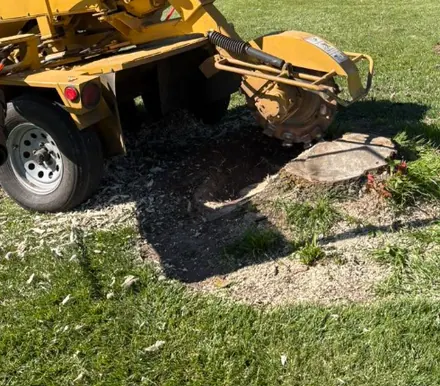
If a tree had to come down, the stump can be ground out too. Grinding needs the buried utilities marked first, so call JULIE at 811. It's free.
Storm Cleanup Mistakes That Get People Hurt or Cost Them Money
We see the same ones after every storm.
- Yanking on a hanging limb from underneath. It comes down, all right. On you.
- Going up a ladder with a chainsaw to finish off a half-broken branch.
- Trying to pull a limb off a wire with a rake or a rope. Wood carries current when it's wet.
- Throwing everything in a pile before taking a single photo.
- Cutting down a good tree in a panic over one lost limb, or keeping a split one because it still has leaves.
- Hiring a stranger with a pickup who wants cash and won't write the price down.
- Forgetting the village. A storm doesn't cancel tree rules. If a damaged tree has to come all the way down, your village may require a permit, so check with village hall first.