When Tree Removal in Libertyville Is the Right Call
Taking a healthy tree down is a last resort, and we'll say so if a trim would fix the problem. But some trees are past that point, and waiting only makes the job riskier.
Here's what usually means a tree has to come out:
- It's dead. No leaves in summer, bark sliding off, branches snapping in an ordinary wind.
- The trunk is split, hollow, or has a long crack running down it.
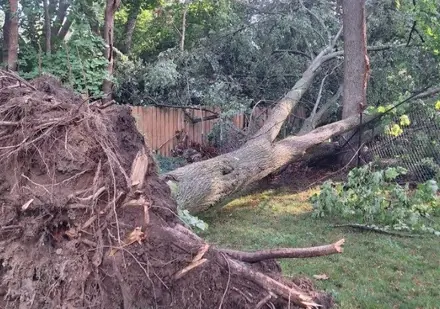
- It's started leaning when it didn't before, or the soil is lifting on one side of the base.
- Big dead limbs hang over the roof, the driveway or the spot where the kids play.
- Roots are lifting the walk or pushing on the foundation, and cutting them would leave the tree unsteady.
- It's simply in the way of an addition, a new garage or a wider driveway.
Dead Ash and Other Trees That Shouldn't Wait
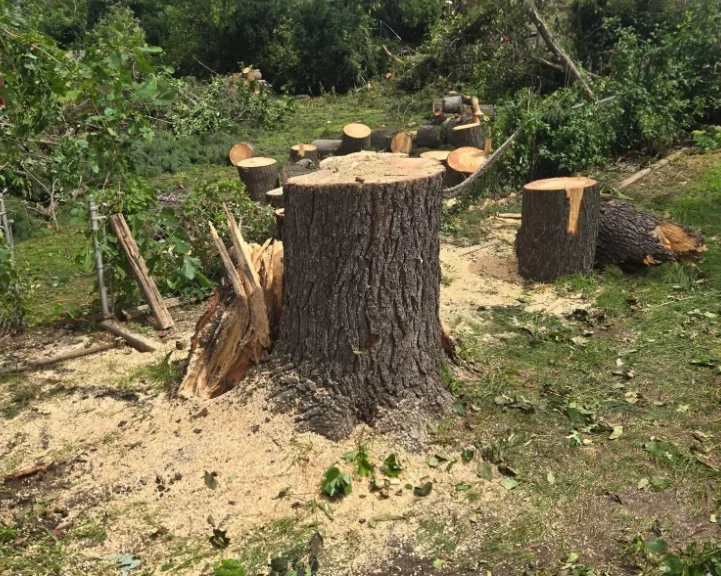
Ash trees are their own story around here. Emerald ash borer has killed most of the untreated ash across Lake County and northern Illinois, and a dead ash gets brittle fast. The longer it stands, the worse it is to take apart. If that's what's in your yard, read about getting an ash down before it turns dangerous.
We don't diagnose or treat tree diseases. We can tell you if a tree is dead or coming apart. Whether a sick tree can be saved is a question for somebody who does treatment.
How We Take a Tree Down in Lake County, Step by Step
Every removal starts with a look, not a chainsaw.
- Look it over. We check which way the tree leans, where the weight sits, what's dead up top, and what's underneath: roof, fence, shed, garden, wires.
- Pick the plan. A tree with room around it can be dropped whole. A tree near anything you care about comes down in pieces.
- Clear the ground. Anything breakable gets moved out of the work zone, and a landing spot is picked for the limbs.
- Limbs first. Branches come off one at a time. Anything over a roof or fence is tied off and lowered on ropes, not dropped.
- Then the trunk. With the limbs gone, the trunk is cut down in short sections from the top until what's left is safe to lay over.
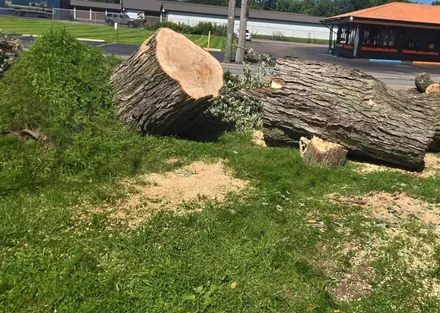
- Chip and cut. Brush goes through the chipper as it reaches the ground. Trunk wood is cut into pieces that can be carried out.
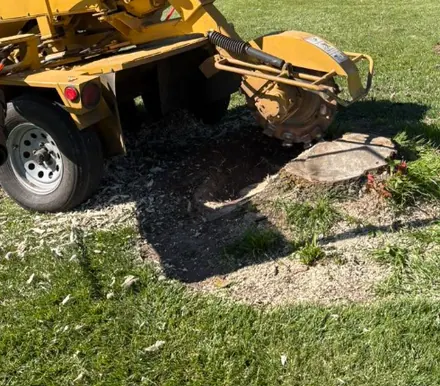
- Stump cut low. The stump is cut close to the ground. Grinding it out is a separate step you can add.
- Rake and haul. The yard is raked and everything leaves with us, unless you asked to keep the wood.
Open-Yard Removal vs. Tight-Spot Removal
When a tree has open lawn on every side, it can be felled in one piece. That means a notch cut on the side facing the fall, then a back cut from the other side. The strip of wood left between them works like a hinge and steers the trunk down. It looks simple. Getting the direction right is the whole job.
Two trees of the same kind and size can still be very different jobs. Where the tree stands decides most of it.
| What changes | Tree in an open yard | Tree over a roof, fence or garage |
|---|---|---|
| How it comes down | Often dropped whole into a clear lane | Taken apart in pieces from the top down |
| Ropes | Used to guide the fall if needed | Used on most cuts to lower wood slowly |
| Time on site | Shorter | Longer, since each piece is handled on its own |
| Risk to what's nearby | Low when there's room | Managed cut by cut, so planning matters more |
| Effect on the price | Lower for that size of tree | Higher, because of the extra labor and care |
What Makes Removing a Tree Harder
Size comes first. A bigger tree has more wood to lower, more brush to chip and more weight in every piece. The really big ones get looked at in person before you get a price. There's more on that under big tree takedowns.
Dead wood is the sneaky one. You'd think a dead tree is easier because it's lighter. It's the opposite. Dead wood is brittle, it can't be trusted to hold a rope the way live wood does, and limbs let go without warning. That's why removing a dead tree gets planned more carefully than a live one.
Then there's access. If the only way into the backyard is a narrow gate or a walk between two houses, every piece of that tree gets carried out by hand. Slopes, soft ground, septic fields and pools all change the plan too.
Wires matter most. The lines along the street and the line from the pole to your house belong to the power company. Working in or touching power lines is off the table for us. If the tree is in the wires, ComEd handles that part first and we take it from there.
Older neighborhoods tend to be the tight-spot kind. A lot of tree removal in Lake Forest means big old oaks that grew up right alongside the house, so there's rarely a clear lane to drop anything.
What Tree Removal Cost Depends On in Lake County IL
We don't post prices, because no two trees are the same job. You get one flat price in writing before any cutting starts, and the quote is free. Here's what moves that number:
- Size of the tree. Taller and wider means more cuts, more rope work and more to haul.
- Where it stands. An open yard is the simple case. Over a roof, fence, garage or wires is not.
- Condition. Dead and brittle wood is slower and riskier to handle than live wood.
- Access. Whether equipment can get close, or the wood has to go out through a gate by hand.
- The stump. Grinding is priced in if you want it and left out if you don't.
Getting a Tree Removal Quote From Photos or a Visit
Small trees can usually be priced from a couple of photos. Stand back far enough to get the whole tree in the frame, then take one of the base and one of whatever it's hanging over. Big removals get a free visit first so nobody's guessing. Our page on how pricing works walks through it.
The process is the same wherever you live in the county. Somebody asking about taking a tree down in Gurnee texts a photo and their town just like somebody two blocks from us in Libertyville, and gets the same kind of written price back.
Tree Removal Permits: Check With Village Hall First
Many Lake County villages have tree rules, and some require a permit before you remove a tree, even one that's entirely on your own lot. The rules aren't the same from one village to the next, so we won't guess at yours.
Your village may require a permit, so check with village hall first, before you book a day. A phone call or a look at the village website usually answers it. A permit is a lot easier to get while the tree is still standing.
If you're in a subdivision with a homeowners association, ask them as well. And if the tree sits near the lot line, talk to your neighbor before anybody starts cutting.
What to Do Before the Tree Removal Crew Arrives
A little prep on your end keeps the day short.
- Move cars out of the driveway and away from the curb near the tree.
- Pull patio furniture, grills, planters and kids' toys well back from the work area.
- Unlock the gate, and tell us if a dog uses the yard.
- Point out anything hidden in the lawn: sprinkler heads, a septic lid, landscape lighting, a buried dog fence.
- Keep kids and pets inside while the saws are running.
- Give the neighbors a heads up, mostly if limbs hang over their side.
- Decide about firewood. If you want the wood, say so and tell us where it should go.
Cleanup, Hauling, the Stump and Mistakes to Avoid
Once the tree is on the ground, the job's about half done. The rest is cleanup. Brush gets chipped, logs get cut and loaded, and the lawn gets raked. Since Illinois keeps yard waste out of landfills, the chips and wood get recycled. Hauling is part of the flat price. That holds for Mundelein tree removal and every other town we drive to.
Want firewood? Tell us before we start and the wood is left cut where you want it. Fresh-cut wood needs time to dry before it burns well, and the splitting is on you. A removal also leaves a stump cut low. If you want it gone so you can mow or grow grass, have grinding put in the price. We don't plant replacement trees, so line that up separately.
The mistakes we'd steer you away from:
- Waiting on a dead tree. Every season it stands, it gets weaker and harder to take down safely.
- Trying it yourself. Limbs swing back, trunks jump off the stump, and a ladder is a bad place to hold a running chainsaw.
- Hiring whoever knocks on the door without asking if they're insured for tree work. We are, and you should ask anyone.
- Asking to have the tree topped instead. Cutting the top flat is bad practice and we don't do it.
- Cutting roots on one side for a patio or driveway and leaving the tree standing. It can go over.