How to Tell a Tree Is Dead and Needs Removal
Summer is the easy time to check. If every other tree on the block is full of leaves and yours is bare, or it leafed out on one side only, something is wrong. Winter is harder, because a dormant tree and a dead one look alike from the street.
Get up close. Scratch a small twig with your thumbnail. Green and damp underneath means that branch is alive. Brown and dry means it isn't. Try a few twigs on different sides before you decide.
One thing to be straight about: we don't diagnose tree diseases or treat sick trees. If your tree is half alive and you want to save it, that's a different kind of visit from somebody else. What we can tell you is whether it's far enough gone to come down, and how we'd do it.
- Bark falling off in sheets, with bare smooth wood showing underneath
- No buds on the twigs in spring, or twigs that snap clean instead of bending
- Mushrooms or shelf fungus growing on the trunk or around the base
- Big dead limbs up top, and smaller ones on the lawn after every windy day
- Woodpeckers working the trunk hard, or sawdust piling up at the base
- A lean that wasn't there before, or soil lifting on one side of the roots
Why Dead Tree Removal in Libertyville Shouldn't Wait
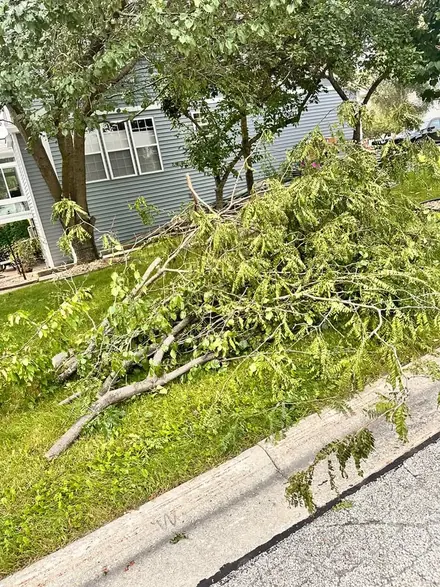
A live tree bends in the wind. A dead one breaks. Once the wood dries out, limbs let go without warning, and not only in storms. A calm afternoon is plenty.
The longer it stands, the worse the job gets. Wood that died recently still holds a rope and a climber. Wood that's been dead a few years gets soft and unpredictable, and that takes away the safer ways of bringing it down. Fewer options means a slower, more expensive job. So the cheap time to remove a dead tree is soon after it dies.
Where it stands matters as much as how dead it is. A dead oak at the back of a wooded lot is one kind of risk. The same tree leaning over a bedroom or the neighbor's fence is another. On the wooded lots near the Des Plaines River, where we handle dead tree removal in Lincolnshire, it's often both at once: big old trees with a house tucked right in among them.
How Our Crew Takes Down a Dead Tree, Step by Step
Every dead tree gets looked over before anyone starts a chainsaw. The plan depends on how sound the wood still is.
The big difference from a live tree is trust. On a healthy maple, a climber can tie into the top and lower a cut limb off a rope anchored in the same tree. On a dead one, we don't assume the wood will hold. Sometimes ropes get anchored in a healthy tree next to it instead. Sometimes pieces are cut smaller so nothing heavy ever swings. It's slower. That's the point.
If you want the full picture of how a standard takedown runs, our tree removal page covers it.
- Check the tree from the ground. We look at the base, the trunk, the big limb unions and the top for rot, cracks and hollow spots.
- Decide how it comes down. With open room and a clear lane, the whole tree can be felled in one piece. Without that, it comes down in sections.
- Clear and protect the drop zone. Patio furniture, grills and planters get moved. Anything that can't move gets covered or worked around.
- Take the top weight off first. Limbs come off from the outside in, lowered on ropes where there's something underneath.
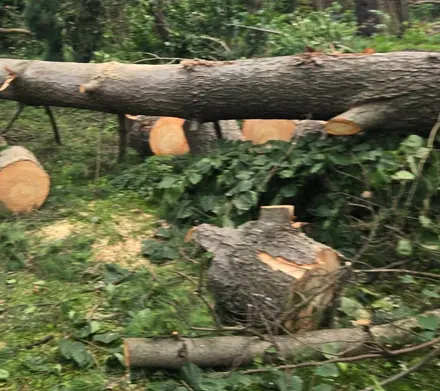
- Bring the trunk down in pieces short enough to control, or fell what's left once the top is gone and there's room.
- Chip the brush, cut and load the wood, rake the yard, and grind the stump if that's part of your price.
What Makes Dead Wood Harder to Remove Than a Live Tree
People assume a dead tree is an easy job because there are no leaves and less weight. It's the opposite. Here's what changes.
The kind of tree matters as well. Ash goes brittle faster than most, which is why we treat taking down a dead ash as its own job. Oak holds together longer, but it's heavy, and a dead oak limb does real damage when it lands.
| What we find | What it means for the job |
|---|---|
| Brittle limbs | They snap instead of bending, so they can't be swung around on a rope the way live limbs can. Pieces get cut smaller. |
| Rot at the base | The tree may not fall where the cut says it should. Felling it in one piece may be off the table. |
| Hollow trunk | Less solid wood to hold a hinge or a rope. The trunk comes down in short sections. |
| Loose bark and dead tops | Things fall on their own while we work. The drop zone gets bigger and stays clear the whole time. |
| Dead for several years | The least predictable wood. Expect a slower job and a closer look before we quote it. |
What the Price of Dead Tree Removal Depends On
You get one flat price in writing before any cutting. It doesn't change halfway through the job. Quotes are free.
Five things set the number: how big the tree is, where it stands, what shape the wood is in, how easy it is to get equipment and brush in and out, and whether the stump is included. On a dead tree, condition carries more weight than usual. Two trees the same size can price differently because one died last year and the other has been rotting since before you bought the house.
Smaller dead trees in open yards can usually be quoted from photos. Text a shot of the whole tree, one of the base, and one showing what's around it. Bigger ones get a free visit first so we can look at the trunk in person. The pricing page walks through how quotes work.
Do You Need a Permit to Remove a Dead Tree in Lake County IL
Maybe. Many Lake County villages have tree rules, and some require a permit before a tree comes down, even on your own property and even if it's plainly dead. Your village may require a permit, so check with village hall first. It's usually a phone call.
We work all over the county, from older in-town lots to lake properties like the ones where we do dead tree work around Wauconda and Bangs Lake, and the rules aren't the same from one village to the next. Don't go by what your cousin's town does. Ask yours.
If the dead tree sits in the strip between the sidewalk and the street, call the village before you call us. That one may be theirs to deal with.
Cleanup, Firewood and the Stump After a Dead Tree Comes Down
When the tree is down, the yard gets cleaned up. Brush goes through the chipper. Logs get cut and hauled away. We rake up the twigs and sawdust so you're not finding pieces in the grass all summer. Illinois keeps yard waste out of landfills, so chips and wood get recycled, not dumped.
Want the wood? Say so when you book and we'll leave it cut where you want it. Fair warning on dead wood: some of it burns fine and some is too far gone to be worth stacking. We'll tell you which you've got.
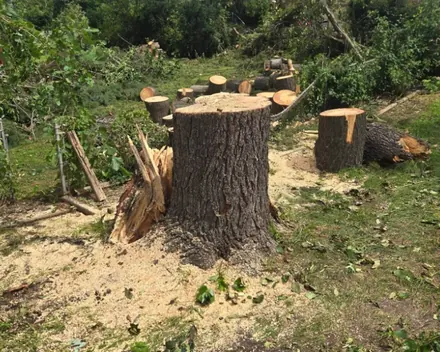
The stump is a separate line on the quote. You can leave it, or add stump grinding so it's gone on the same job. Underground utilities have to be marked before grinding. In Illinois that's a free call to JULIE at 811.
What to Do First If You Think Your Tree Is Dead
Start by keeping people out from under it. Move the car, the trampoline, the dog run. Don't hang a swing or a hammock on it, and don't let anyone climb it.
Then take pictures and text them to (224) 944-8652 with your town. Or use the contact page if you'd rather type it out. We're open Monday through Saturday, 7am to 7pm, and Sunday by appointment.
If the tree or a big limb has already come down on a house, a car or across the driveway, call. Don't text. Storm calls get handled as fast as the crew can get there. And if it's touching or tangled in power lines, stay back and call ComEd first. Lines are the power company's job, and we don't work in or touching them.
Once you have a date, a little prep makes the day go smoother:
- Check with village hall about a permit
- Unlock the gate and tell us about sprinkler heads, septic lids, dog fences and anything buried
- Move cars out of the driveway so there's room to work and load
- Let the neighbors know if the tree hangs over their side
- Keep kids and pets inside while we're cutting
Mistakes People Make With Dead Trees
Waiting for it to fall on its own. It will, eventually, and you don't get to pick the direction or the day.
Cutting it yourself because it looks light. Dead trees don't fall the way the notch says they should. Rotten wood doesn't hold a hinge, and tops break off and come straight back down. This is the tree homeowners get hurt on.
Leaning a ladder on it. A ladder against dead wood is trusting the one thing you already know is failing.
Taking off only the dead limbs and leaving the dead trunk. If the whole tree is gone, trimming it buys you a shorter dead tree.
Thinking only big old trees are a problem. A mid-size dead tree in a fenced backyard, the kind we see when quoting a dead tree in Lindenhurst and other subdivision towns, can be a tighter job than a giant in an open field, because it's planted close to a fence, a shed or a play set.